
How to teach spelling

Spelling, grammar and punctuation (otherwise known as SPaG) is assessed in several GCSE subjects, from English to History, to Business and Physical Education. For this reason alone, it is worth considering how we can better equip students to develop a range of spelling strategies.
Much of the instruction on spelling in primary schools focuses on phonics (matching the sounds of letters to the correct letter or groups of letters). In the classroom, students will be asked to ‘sound it out’, or ‘divide the word into syllables.’ This approach fails to consider the rich complexity of the English language and it is often not helpful to children.
It also ignores recent research which highlights the importance of developing many approaches: morphological, semantic, etymological and syntactical knowledge. Masterson and Apel’s Repertoire Theory argues that to decode the spelling of unfamiliar words learners rely on a range of strategies (2010, cited in Gillon, 2018).
Teaching a phonetic approach — where the phonetic approach breaks down:
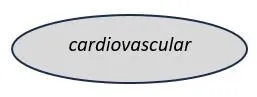
- The hard initial hard ‘c’ sound can also be true of the letter ‘k’.
- The ‘dio’ letter combination is tricky as learners may expect a diphthong like ‘oe’ or ‘ow’.
- It is also tricky because ‘io’ is not a common vowel combination in English.
- The hard ‘c’ sound in the fifth syllable can be true of the letter ‘k’.
- The final syllable contains a weak vowel sound ‘ar’ which students often mistake as ‘er’.
- The fact that it is a 6 syllable word taxes working memory as the student must labour to determine the correct spelling of each syllable.
- Some 80% of the words used in Science and Maths subjects have Latin or Greek roots which means that English phonics is a much less effective spelling strategy for these academic terms.
Teaching underpinned by Masterson and Apel’s Repertoire Theory (2010):
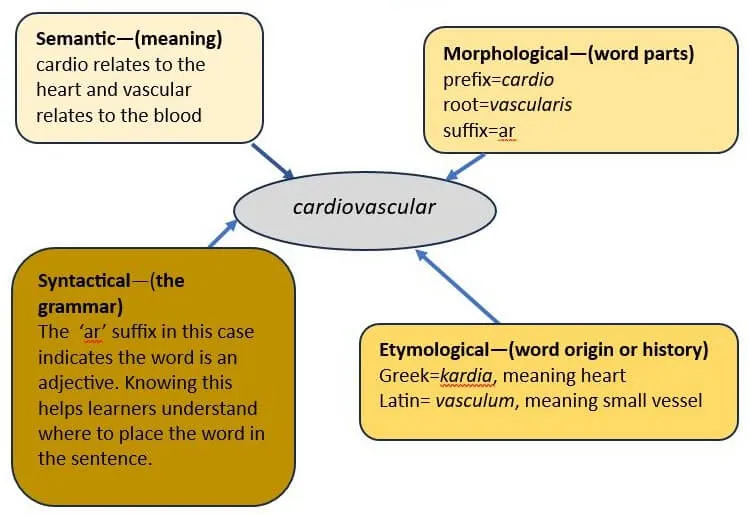
Building learners’ semantic, morphological, syntactical and etymological knowledge will also help them spell words which use the same roots or affixes. Using the example of cardiovascular, students learning the prefix ‘cardio’ can use this to spell words related words like cardiologist and cardiology. Adoniou (2014) argues that English morphemes are quite consistent and can be used to improve both spelling and vocabulary acquisition. Visual and phonetic strategies alone, Adoniou (2014) contends, are not sufficient in helping learners acquire good spelling skills.
Advice from another spelling expert is also worth considering. Lyn Stone (2021) advocates using a spelling formula and a vowel generator to help students develop more accurate spelling.
Sources:
Adoniou, M. (2014) ‘What should teachers know about spelling?’, Literacy, 48(3), pp. 144–154. https://doi.org/10.1111/lit.12017
Gillon, G. (2018) Phonological Awareness from research to practice. 2nd edn. New York: The Guilford Press.
Stone, L. (2021) Spelling for Life. 2nd edn. London: Routledge.